

Lent in the Year of Mercy

thNow that we have marked Ash Wednesday and the start of the Holy Season of Lent, it may be useful to remind ourselves of what Lent is about and learn (or re-discover) some of the wonderful things we can do, to assist in our making the most of this season.

A useful resource for giving different suggestions of activities, can be found on the website of the Bishop’s Conference of the USA: http://www.usccb.org/prayer-and-worship/liturgical-year/lent/upload/lent-2016-calendar.pdf

In his second encyclical as Pope, St. John Paul II writes,  (in Dives in Misericordia) “mercy is manifested in its true and proper aspect when it restores to value, promotes and draws good from all the forms of evil existing in the world and in man” (DM, 6). This means that we are merciful when we respond to evil with good. We see this lesson first taught by Jesus as He tells us to turn the other cheek and shows us the application of this by bringing humanity eternal life from His Death. At the end of each Lent we celebrate this gift in particular by meditating on the evil brought upon the Son of God during Holy Week, and then the good He brings out of this evil through His resurrection on Easter Sunday.

God has shown us His Mercy. He has brought the greatest good from the greatest evil. In our Christian life, we must strive to imitate God and love like He loves and “be merciful, even as your Father is merciful” (Luke 6:36).  It’s good to note that we cannot do evil to bring about good, but in the face of the evil that we experience we must only respond with good.

Ideas for the Lent of Mercy

The tradition of Lent, is offering sacrifices and sufferings up as penance for the forgiveness of sins. This truth of Redemptive Suffering allows us to make up for the wrongs we have done as we rejoice in our sufferings, and in our flesh “complete what is lacking in Christ’s afflictions for the sake of his body, that is, the church” (Col. 1:24). We are able to do penance for our sins and the sins of others and, in a way, participate in the Mercy of God. This could include offering up every suffering as a sacrifice throughout your day. Some ideas could be:

  • Getting up at the first alarm and offering it for someone you know who is struggling
  • Saying yes to anything (reasonable) others ask of you and offering it up for them
  • Letting people in front of you in traffic and praying for them at the same time
  • Take cold showers and offer it up for friends and family
  • Put a pebble in your shoe and offer it up for priests and religious
  • When you have the choice, pick foods you want the least and offer this up for those who are spiritually poor
  • Go on a spending freeze. Practice the spirit of poverty by not buying anything that is not absolutely essential
  • Maintain silence. This can include not turning on the radio and not always speaking freely your thoughts and opinions. Practice the virtue of silence and grow in your ability to really listen to others
  • Fast on bread and water on certain days to master your will

The Corporal and Spiritual Works of Mercy taught by the Church show us many ways to bring good from the bad. We could make it a goal to intentionally seek ways to practice these works this Lent. This will include:

Corporal Works of Mercy-

1) Feed the hungry

2) Give drink to the thirsty

3) Clothe the naked

4) Shelter the homeless

5) Visit the sick

6) Visit the imprisoned

7) Bury the dead

Spiritual Works of Mercy-

1) Counsel the doubtful

2) Instruct the ignorant

3) Admonish sinners

4) Comfort the afflicted

5) Forgive offenses

6) Bear wrongs patiently

7) Pray for the living and the dead

Be Merciful to Jesus

We can be merciful to Jesus this Lent. St. John Paul II explains, “Christ, precisely as the crucified one, is the Word that does not pass away, and He is the one who stands at the door and knocks at the heart of every man, without restricting his freedom, but instead seeking to draw from this very freedom love, which is not only an act of solidarity with the suffering Son of man, but also a kind of ‘mercy’ shown by each one of us to the Son of the eternal Father” (DM, 8). We show Christ mercy by loving Him. We can love him through seeking to nourish our relationship with Him and by avoiding sins that hurt our relationship with Him.

I am sure that we can come up with a plethora of ideas, but here are a few to help:

-Daily Rosary

-The Divine Mercy Chaplet recited at 3.00pm (Publicly in the JPII Oratory in Rosyth on a Friday)

-Time in Adoration (either exposed on the altar or reposed in the tabernacle)

-Daily reading of Scripture

-The Stations of the Cross

-Frequenting the Sacraments

-Consecration to Jesus through Mary by the St. Louis de Montfort method.


Extra ordinary Jubilee Year of Mercy

  • thIn May 2015, Pope Francis declared that there would be a Jubilee Year of Mercy from December 8, 2015 to November 20, 2016. Obviously, this is not a calendar year, but a special church year that extends from the Feast of the Immaculate Conception in 2015 to the Feast of Christ the King in 2016, the last Sunday before the start of Advent.

    The practice of a jubilee year has ancient roots in the Jewish tradition and evidence for it can be found in the Old Testament (for example, see Leviticus 25).  The jubilee year was called every fifty years and was a time for forgiveness.  It stood as a reminder of God’s providence and mercy.  The dedication of a year for this emphasis provided the community with a time to come back into right relationship with one another and with God.  As the practice of the jubilee year was adopted into the Catholic Church, these themes of mercy, forgiveness, and solidarity continued and the jubilee year is celebrated every 25 years.

    However, Pope Francis has declared this an Extraordinary Jubilee Year, because it falls outside the 25-year cycle in order to emphasize the need to direct our attention to need for Mercy.

    Why a Year of Mercy?

    Pope Francis said he declared this year of mercy to direct our attention and actions “on mercy so that we may become a more effective sign of the Father’s actions in our lives . . . a time when the witness of believers might grow stronger and more effective.” He also said:

    “Here, then, is the reason for the Jubilee: because this is the time for mercy. It is the favourable time to heal wounds, a time not to be weary of meeting all those who are waiting to see and to touch with their hands the signs of the closeness of God, a time to offer everyone, everyone, the way of forgiveness and reconciliation. May the Mother of God open our eyes, so that we may comprehend the task to which we have been called; and may she obtain for us the grace to experience this Jubilee of Mercy as faithful and fruitful witnesses of Christ.”

Today’s Feast – the Holy Innocents

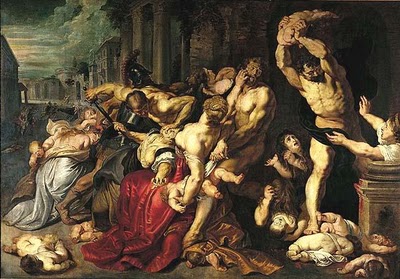
rubens-massacre-of-the-holy-innocents.jpegHerod “the Great,” king of Judea, was unpopular with his people because of his connections with the Romans and his religious indifference. Hence he was insecure and fearful of any threat to his throne. He was a master politician and a tyrant capable of extreme brutality. He killed his wife, his brother and his sister’s two husbands, to name only a few.

Matthew 2:1-18 tells this story: Herod was “greatly troubled” when astrologers from the east came asking the whereabouts of “the newborn king of the Jews,” whose star they had seen. They were told that the Jewish Scriptures named Bethlehem as the place where the Messiah would be born. Herod cunningly told them to report back to him so that he could also “do him homage.” They found Jesus, offered him their gifts and, warned by an angel, avoided Herod on their way home. Jesus escaped to Egypt.

Herod became furious and “ordered the massacre of all the boys in Bethlehem and its vicinity two years old and under.” The horror of the massacre and the devastation of the mothers and fathers led Matthew to quote Jeremiah: “A voice was heard in Ramah, sobbing and loud lamentation; Rachel weeping for her children…” (Matthew 2:18). Rachel was the wife of Jacob/Israel. She is pictured as weeping at the place where the Israelites were herded together by the conquering Assyrians for their march into captivity.

The Holy Innocents are few, in comparison to the genocide and abortion of our day. But even if there had been only one, we recognize the greatest treasure God put on the earth—a human person, destined for eternity and graced by Jesus’ death and resurrection.

100 Years ago today…

The Tablet      Page 28, 6th November 1915

ALL SOULS’ DAY AT ROSYTH, SCOTLAND. (FROM A CORRESPONDENT.)

th

A great gathering of Catholic sailors took place at Rosyth Naval Base on All Souls’ Day. Between 2,300 and 3,000 participated in the Requiem service held for the repose of the souls of those of their comrades who had died in the course of the war. A huge building was placed by the authorities at the disposal of the Rev. Father Sweeney, Inverkeithing, by whom the bulk of the arrangements were carried out. Such an assembly under one roof of so large a number of Catholic sailors is practically unique, yet their numbers were less than a tithe of the Catholic men from Great Britain and the Colonies of the Empire serving in the Fleet. A temporary altar with pulpit platform and catafalque was erected for the service. Over the catafalque was spread a Union Jack. The Bishop of Dunkeld officiated in presence of the Bishop of Aberdeen, assisted by Father Sweeney, Father Robertson (Dunfermline), and the Rev. Dr. Connolly (Inverkeithing). The duties of cross-bearer and altar servers were undertaken by midshipmen of the Fleet. The music of the English hymns was rendered by a naval orchestra, and the singing of the sailor congregation was marked by striking fervour and volume, and thrilled the few privileged visitors who were spectators of the wonderful gathering.

After Mass the Rev. Father Davidson, C.SS.R., ascended the pulpit and delivered a stirring discourse. He said that he was but voicing the feeling of all present in publicly thanking those whose gracious permission had made that assembly possible. It had given them the chance of performing a duty dear to the Catholic heart of honouring the brave .and helping our dead. Never in the annals of the Church in this country, nay, nowhere in the pages of the history of our nation may be found the record of any similar assembly. “We are here to honour and help our dead. Their end has been glorious. They who go down to the sea in ships of war to do battle carry their lives in their hands. The only peril of the years gone by was shot and shell belched forth from the oaken sides of the men-of-war. In these our day’s human ingenuity has exceeded itself in devising means of destruction and of sending men to death in crowds. There are on all sides the secret perils of the deep, the submarine with its torpedo and the hidden mine. The methods have changed, but the spirit is the same. Courage, we know, never deserts our fighting men. Brethren, I would not have you disconsolate concerning those who have fallen asleep. ‘The souls of the just are in the hands of God,’ and we believe He will bring a part through fire. Here is our hope for those who were not perfect in life—and who is perfect? Who shall go up to the mountain of the Lord, who shall stand in the holy place?—the innocent in hands and the clean of heart. They lie there to be cleansed yet more. ‘As silver is refined I will refine them.’ They are there to pay back the debt of temporal punishment due to sin of which the guilt has been forgiven, and they are helped by the suffrages of the faithful. They need your prayers and sacrifices. You, my dearest brethren, have still to face the perils of the deep for this war is not yet won. Your watchword is Be ye ready, aye ready’ to meet the foe. The Fleet of England is her all in all. Her Fleet is in your hands, and in the Fleet her fate. You, under the Most High, must prove the instrument to crush the Prussian lust for power, that lust which has made rivers of blood and ruined the homes of a peaceful people. It is your work to help to restrain and confine within limits a civilization gone mad, to teach a nation that a nation’s word is her bond. Your work to guard our shores by day and night, to watch the bright horizon line or peer into the fog Lo watch for foemen. And your sailor King and Country trust you every man, from the admirals in supreme command to the humble toiler in the stokeholds. God bless and strengthen you in your labour, and protect you in the watch and send you home the victors.” The Absolutions were given by the Bishop of Aberdeen and the Bishop of Dunkeld, and in conclusion the National Anthem was played by the orchestra.

Today’s Feast – St John Paul II

1016412_10152387872371766_5501098396688450904_nSaint John Paul II is perhaps one of the most well-known pontiffs in recent history, and is most remembered for his charismatic nature, his love of youth and his world travels, along with his role in the fall of communism in Europe during his 27-year papacy.

Karol Józef Wojtyla, known as John Paul II since his October 1978 election to the papacy, was born in the Polish town of Wadowice, a small city 50 kilometers from Krakow, on May 18, 1920. He was the youngest of three children born to Karol Wojtyla and Emilia Kaczorowska. His mother died in 1929. His eldest brother Edmund, a doctor, died in 1932 and his father, a non-commissioned army officer died in 1941. A sister, Olga, had died before he was born.

He was baptized on June 20, 1920 in the parish church of Wadowice by Fr. Franciszek Zak, made his First Holy Communion at age 9 and was confirmed at 18. Upon graduation from Marcin Wadowita high school in Wadowice, he enrolled in Krakow’s Jagiellonian University in 1938 and in a school for drama.

The Nazi occupation forces closed the university in 1939 and young Karol had to work in a quarry (1940-1944) and then in the Solvay chemical factory to earn his living and to avoid being deported to Germany.

In 1942, aware of his call to the priesthood, he began courses in the clandestine seminary of Krakow, run by Cardinal Adam Stefan Sapieha, archbishop of Krakow. At the same time, Karol Wojtyla was one of the pioneers of the “Rhapsodic Theatre,” also clandestine.

After the Second World War, he continued his studies in the major seminary of Krakow, once it had re-opened, and in the faculty of theology of the Jagiellonian University. He was ordained to the priesthood by Archbishop Sapieha in Krakow on November 1, 1946.

Shortly afterwards, Cardinal Sapieha sent him to Rome where he worked under the guidance of the French Dominican, Garrigou-Lagrange. He finished his doctorate in theology in 1948 with a thesis on the subject of faith in the works of St. John of the Cross (Doctrina de fide apud Sanctum Ioannem a Cruce). At that time, during his vacations, he exercised his pastoral ministry among the Polish immigrants of France, Belgium and Holland.

In 1948 he returned to Poland and was vicar of various parishes in Krakow as well as chaplain to university students. This period lasted until 1951 when he again took up his studies in philosophy and theology. In 1953 he defended a thesis on “evaluation of the possibility of founding a Catholic ethic on the ethical system of Max Scheler” at Lublin Catholic University. Later he became professor of moral theology and social ethics in the major seminary of Krakow and in the Faculty of Theology of Lublin.

On July 4, 1958, he was appointed titular bishop of Ombi and auxiliary of Krakow by Pope Pius XII, and was consecrated September 28, 1958, in Wawel Cathedral, Krakow, by Archbishop Eugeniusz Baziak.

On January 13, 1964, he was appointed archbishop of Krakow by Pope Paul VI, who made him a cardinal June 26, 1967 with the title of S. Cesareo in Palatio of the order of deacons, later elevated pro illa vice to the order of priests.

Besides taking part in Vatican Council II (1962-1965) where he made an important contribution to drafting the Constitution Gaudium et spes, Cardinal Wojtyla participated in all the assemblies of the Synod of Bishops.

The Cardinals elected him Pope at the Conclave of 16 October 1978, and he took the name of John Paul II. On 22 October, the Lord’s Day, he solemnly inaugurated his Petrine ministry as the 263rd successor to the Apostle. His pontificate, one of the longest in the history of the Church, lasted nearly 27 years.

Driven by his pastoral solicitude for all Churches and by a sense of openness and charity to the entire human race, John Paul II exercised the Petrine ministry with a tireless missionary spirit, dedicating it all his energy. He made 104 pastoral visits outside Italy and 146 within Italy. As bishop of Rome he visited 317 of the city’s 333 parishes.

He had more meetings than any of his predecessors with the People of God and the leaders of Nations. More than 17,600,000 pilgrims participated in the General Audiences held on Wednesdays (more than 1160), not counting other special audiences and religious ceremonies [more than 8 million pilgrims during the Great Jubilee of the Year 2000 alone], and the millions of faithful he met during pastoral visits in Italy and throughout the world. We must also remember the numerous government personalities he encountered during 38 official visits, 738 audiences and meetings held with Heads of State, and 246 audiences and meetings with Prime Ministers.

His love for young people brought him to establish the World Youth Days. The 19 WYDs celebrated during his pontificate brought together millions of young people from all over the world. At the same time his care for the family was expressed in the World Meetings of Families, which he initiated in 1994.

John Paul II successfully encouraged dialogue with the Jews and with the representatives of other religions, whom he several times invited to prayer meetings for peace, especially in Assisi.

Under his guidance the Church prepared herself for the third millennium and celebrated the Great Jubilee of the year 2000 in accordance with the instructions given in the Apostolic Letter Tertio Millennio adveniente. The Church then faced the new epoch, receiving his instructions in the Apostolic Letter Novo Millennio ineunte, in which he indicated to the faithful their future path.

With the Year of the Redemption, the Marian Year and the Year of the Eucharist, he promoted the spiritual renewal of the Church.

He gave an extraordinary impetus to Canonizations and Beatifications, focusing on countless examples of holiness as an incentive for the people of our time. He celebrated 147 beatification ceremonies during which he proclaimed 1,338 Blesseds; and 51 canonizations for a total of 482 saints. He made Thérèse of the Child Jesus a Doctor of the Church.

He considerably expanded the College of Cardinals, creating 231 Cardinals (plus one in pectore) in 9 consistories. He also called six full meetings of the College of Cardinals.

He organized 15 Assemblies of the Synod of Bishops – six Ordinary General Assemblies (1980, 1983, 1987, 1990, 1994 and 2001), one Extraordinary General Assembly (1985) and eight Special Assemblies (1980,1991, 1994, 1995, 1997, 1998 (2) and 1999).

His most important Documents include 14 Encyclicals, 15 Apostolic Exhortations, 11 Apostolic Constitutions, 45 Apostolic Letters.

He promulgated the Catechism of the Catholic Church in the light of Tradition as authoritatively interpreted by the Second Vatican Council. He also reformed the Eastern and Western Codes of Canon Law, created new Institutions and reorganized the Roman Curia.

As a private Doctor he also published five books of his own: “Crossing the Threshold of Hope” (October 1994), “Gift and Mystery, on the fiftieth anniversary of my ordination as priest” (November 1996), “Roman Triptych” poetic meditations (March 2003), “Arise, Let us Be Going” (May 2004) and “Memory and Identity” (February 2005).

In the light of Christ risen from the dead, on 2 April a.D. 2005, at 9.37 p.m., while Saturday was drawing to a close and the Lord’s Day was already beginning, the Octave of Easter and Divine Mercy Sunday, the Church’s beloved Pastor, John Paul II, departed this world for the Father.

From that evening until April 8, date of the funeral of the late Pontiff, more than three million pilgrims came to Rome to pay homage to the mortal remains of the Pope. Some of them queued up to 24 hours to enter St. Peter’s Basilica.

On April 28, the Holy Father Benedict XVI announced that the normal five-year waiting period before beginning the cause of beatification and canonization would be waived for John Paul II. The cause was officially opened by Cardinal Camillo Ruini, vicar general for the diocese of Rome, on June 28 2005, and he was beatified May 1, 2011.

On April 27 , 2014 he was canonized by Pope Francis during a ceremony in St. Peter’s Square.

In an April 24 message sent to the Church in Poland, Pope Francis gave thanks for the great “gift” of the new Saint, saying of John Paul II that he is grateful, “as all the members of the people of God, for his untiring service, his spiritual guidance, and for his extraordinary testimony of holiness.”