

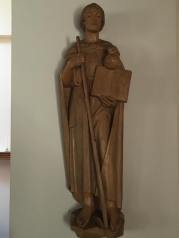
Today is the Feast of St Columba, one of our parish’s co-patrons:

st columba statueSaint Columba, in Irish: Colm Cille, ‘church dove’; was born on the 7th December 521 and died on this date, 9th June, in 597. He was an Irish abbot and missionary credited with spreading Christianity in what is today our country of Scotland at the start of the Hiberno-Scottish mission. He founded the important abbey on Iona, which became a dominant religious and political institution in the region for centuries. He was highly regarded by both the Gaels of Dál Riata and the Picts, and is remembered today as a Christian saint and one of the Twelve Apostles of Ireland.

St Columba studied under some of Ireland’s most prominent church figures and founded several monasteries in the country. Around 563 he and his twelve companions crossed to Dunaverty near Southend, Argyll in Kintyre before settling in Iona in Scotland, then part of the Irish kingdom of Dál Riata, where they founded a new abbey as a base for spreading Christianity among the northern Pictish kingdoms who were in the most part pagan. He remained active in Irish politics, though he spent most of the remainder of his life in Scotland.

Locally, Inchcolm Island which lies in the boundaries of our parish is named after St Columba, and legend has it, he visited in 567 AD. Whatever the truth of this may be, we do know that the Church has had a long history on the island, with monastic buildings dating back to the 10th century, although the main monastery was built in the 12th century, with the Church of St John’s Rosyth being part of the lands of the monastery based on the Island of Columba.

Let us pray through the intercession of St Columba, and indeed of all our local saints, that we may carry on their legacy of living out our faith with love and devotion and passing the joy of the Good News of Jesus on to others.

Month of the Sacred Heart

sacred-heart-of-jesus.gifJune is the month of the Sacred Heart of Jesus, a month dedicated to contemplating the love of God made flesh in the heart of Jesus Christ. We are invited in this month to consider the charity of the heart of Jesus and seek to grow in love for Him and for those around us. The Solemnity of the Sacred Heart is Friday, June 3.
As a way to deepen our devotion to the Sacred Heart of Jesus, we are invited to pray with this litany during this month:

Heart of Jesus, Son of the Eternal Father, have mercy on us.

Heart of Jesus, formed by the Holy Spirit in the womb of the Virgin Mother, have mercy on us.

Heart of Jesus, substantially united to the Word of God, have mercy on us.

Heart of Jesus, of Infinite Majesty, have mercy on us.

Heart of Jesus, Sacred Temple of God, have mercy on us.

Heart of Jesus, Tabernacle of the Most High, have mercy on us.

Heart of Jesus, House of God and Gate of Heaven, have mercy on us.

Heart of Jesus, burning furnace of charity, have mercy on us.

Heart of Jesus, abode of justice and love, have mercy on us.

Heart of Jesus, full of goodness and love, have mercy on us.

Heart of Jesus, abyss of all virtues, have mercy on us.

Heart of Jesus, most worthy of all praise, have mercy on us.

Heart of Jesus, king and center of all hearts, have mercy on us.

Heart of Jesus, in whom are all treasures of wisdom and knowledge, have mercy on us.

Heart of Jesus, in whom dwells the fullness of divinity, have mercy on us.

Heart of Jesus, in whom the Father was well pleased, have mercy on us.

Heart of Jesus, of whose fullness we have all received, have mercy on us.

Heart of Jesus, desire of the everlasting hills, have mercy on us.

Heart of Jesus, patient and most merciful, have mercy on us.

Heart of Jesus, enriching all who invoke Thee, have mercy on us.

Heart of Jesus, fountain of life and holiness, have mercy on us.

Heart of Jesus, propitiation for our sins, have mercy on us.

Heart of Jesus, loaded down with opprobrium, have mercy on us.

Heart of Jesus, bruised for our offenses, have mercy on us.

Heart of Jesus, obedient to death, have mercy on us.

Heart of Jesus, pierced with a lance, have mercy on us.

Heart of Jesus, source of all consolation, have mercy on us.

Heart of Jesus, our life and resurrection, have mercy on us.

Heart of Jesus, our peace and our reconciliation, have mercy on us.

Heart of Jesus, victim for our sins, have mercy on us.

Heart of Jesus, salvation of those who trust in Thee, have mercy on us.

Heart of Jesus, hope of those who die in Thee, have mercy on us.

Heart of Jesus, delight of all the Saints, have mercy on us.

V. Jesus, meek and humble of heart.
R. Make our hearts like your heart.

Let us pray;
Almighty and eternal God, look upon the Heart of Thy most beloved Son and upon the praises and satisfaction which He offers Thee in the name of sinners; and to those who implore Thy mercy, in Thy great goodness, grant forgiveness in the name of the same Jesus Christ, Thy Son, who livest and reigns with Thee forever and ever. Amen.

Pastoral Letter for Communications Sunday

50TH  WORLD  COMMUNICATIONS  DAY

My Dear brothers and sisters in Christ

This year’s Communications Sunday message is addressed to us during the Holy Year of Mercy and in his theme, Pope Francis invites us to reflect on the relationship between communication and mercy.

At first sight, that may seem an odd request, we may think of communications as purely functional;  the means by which we impart or convey information to one another.   It may be difficult to see how the transmission of ideas or information can be merciful or otherwise.

If we think for a moment, however, it is clear that mercy is very much a part of all that we do and importantly, of what we say.   As the Pope’s puts it:  “What we say and how we say it, our every word and gesture, ought to express God’s compassion, tenderness and forgiveness for all.   Love, by its nature, is communication;  it leads to openness and sharing.   If our hearts and actions are inspired by charity, by divine love, then our communication will be touched by God’s own power.”

The need to speak with care and compassion is especially important in the digital world of social media.   As Christians we must always build bridges and open doors to dialogue and understanding.   The immediacy and instantaneousness of social media can sometimes tempt us towards angry exchanges and aggressive language.   Hurling insults and abuse will simply entrench misunderstanding and close hearts and minds.

As Pope Francis reminds us, when communicating digitally, we may not see the person we are engaging with, but the dignity and respect we bring to our actual encounters should always be present in our digital ones.

On this Communications Sunday I ask you to consider if you always communicate with mercy and if not, to pay attention to the needs of those we communicate with, always remembering their innate human dignity.

I also ask you to give your support to those employed by the Church to communicate her message to a wider audience.   They need your prayers and rely on your generosity to fulfil the responsibilities placed upon them.

I thank you on behalf of the Bishops of Scotland for your willingness to support the work of our communicators within the church and I hope that you will keep them and the work that you do in your prayers.

Yours devotedly in Christ

+Philip Tartaglia
Archbishop of Glasgow
President, Communications Commission of the Bishops’ Conference of Scotland

This joyful Easter tide…

th.jpg

Eastertide is the time of new life. Our Saviour’s in the first place, living for ever a life which belongs no more to the earth and which one day we shall share with Him in heaven. And then our own lives — from Christ to us — for we have more than the assurance of rejoining Him; snatched by Him from the power of the devil we belong to Him as His by right of conquest and we share His life.

DIRECTIONS

Easter week is the week of the baptised. They have passed from death to life, from the darkness of sin to the life of grace in the light of Christ. Wherever there are neophytes, the Easter season, and particularly the first week, is the period of postbaptismal catechesis or mystogogy The community shares with them a deepening understanding of the paschal mystery and an ever greater assimilation of it in daily life through meditation, participation in the Eucharist, and the practice of charity.

The moral requirements of the new life are recalled throughout Eastertide. They are governed by the principle enunciated by St. Paul that, risen with Christ, the Christian must raise his desires to heaven, detach himself from earthly pleasures in order to love those of heaven. It is the work of the Holy Spirit to complete the formation in the baptized of the “new man” who, by the holiness of his life, bears witness to Christ crucified.

The Fifty days from Easter Sunday to Pentecost are celebrated in joyful exultation as one feast day, or better as one “great Sunday.”

These above all others are the days for the singing of the Alleluia.

The Sundays of this season rank as the paschal Sundays and, after Easter Sunday itself, are called the Second, Third, Fourth, Fifth, Sixth, and Seventh Sundays of Easter. The period of fifty sacred days ends on Pentecost Sunday. The first eight days of the Easter Season make up the octave of Easter and are celebrated as solemnities of the Lord.

On the fortieth day after Easter the Ascension is celebrated, except in places where, not being a holy day of obligation, it has been transferred to the Seventh Sunday of Easter. This solemnity directs our attention to Christ, who ascended into heaven before the eyes of his disciples, who is now seated at the right hand of the Father, invested with royal power, who is there to prepare a place for us in the kingdom of heaven; and who is destined to come again at the end of time.

The weekdays after the Ascension until the Saturday before Pentecost inclusive are a preparation for the coming of the Holy Spirit, the Paraclete.

This sacred season of fifty days comes to an end on Pentecost Sunday, which commemorates the giving of the Holy Spirit to the apostles, the beginnings of the Church and its mission to every tongue and people and nation. (Excerpted from the General Norms for the Liturgical Year and Ceremonial of Bishops)